
Human error as a starting point
Describing an error does not explain why it was likely. Available information, interfaces, workload and conditions help explain how the decision arose. Knowing that someone made…
Read the insight ↗ SAFETY FIRSTPEOPLE FIRSTPASQUALE MAGLIULO
MY WORK
From an anomaly to the conditions that made it possible: understand the problem before selecting an action.
A cause analysis starts with a factual problem statement: what happened, where, when and how it differed from the expected result. It can address a nonconformity, a recurring error or an operational difficulty. The aim is to identify conditions that can be improved and verify the result.
The 5 Whys help develop questions. They do not require stopping at the fifth answer or finding a single cause. Each link needs evidence. ‘Human error’ opens further questions about information, tools, competence and work organisation; it does not close the analysis.
Separate facts, effects and hypotheses. Identify the expected result and the observed deviation.
Examine records, document versions and operating conditions, and listen to the people involved.
Develop several branches where needed and verify the proposed links between conditions and effects.
Connect each action to an identified condition, with an owner and a completion date.
Agree how the result will be assessed and check whether the problem recurs.
Three issued documents contain outdated data. The following chain is a set of hypotheses to test, not a report of an actual case.
Compare this explanation with documents, dates and interviews before accepting it. Explore alternative branches, including interfaces, workload, access and training. A plausible chain is not yet a demonstrated cause.
Describing an error does not explain why it was likely. Available information, interfaces, workload and conditions help explain how the decision arose. Knowing that someone made…
Read the insight ↗
A control never planned differs from one planned but unusable. Distinguishing them guides corrective action and review of system responsibilities. After an event, I would start…
Read the insight ↗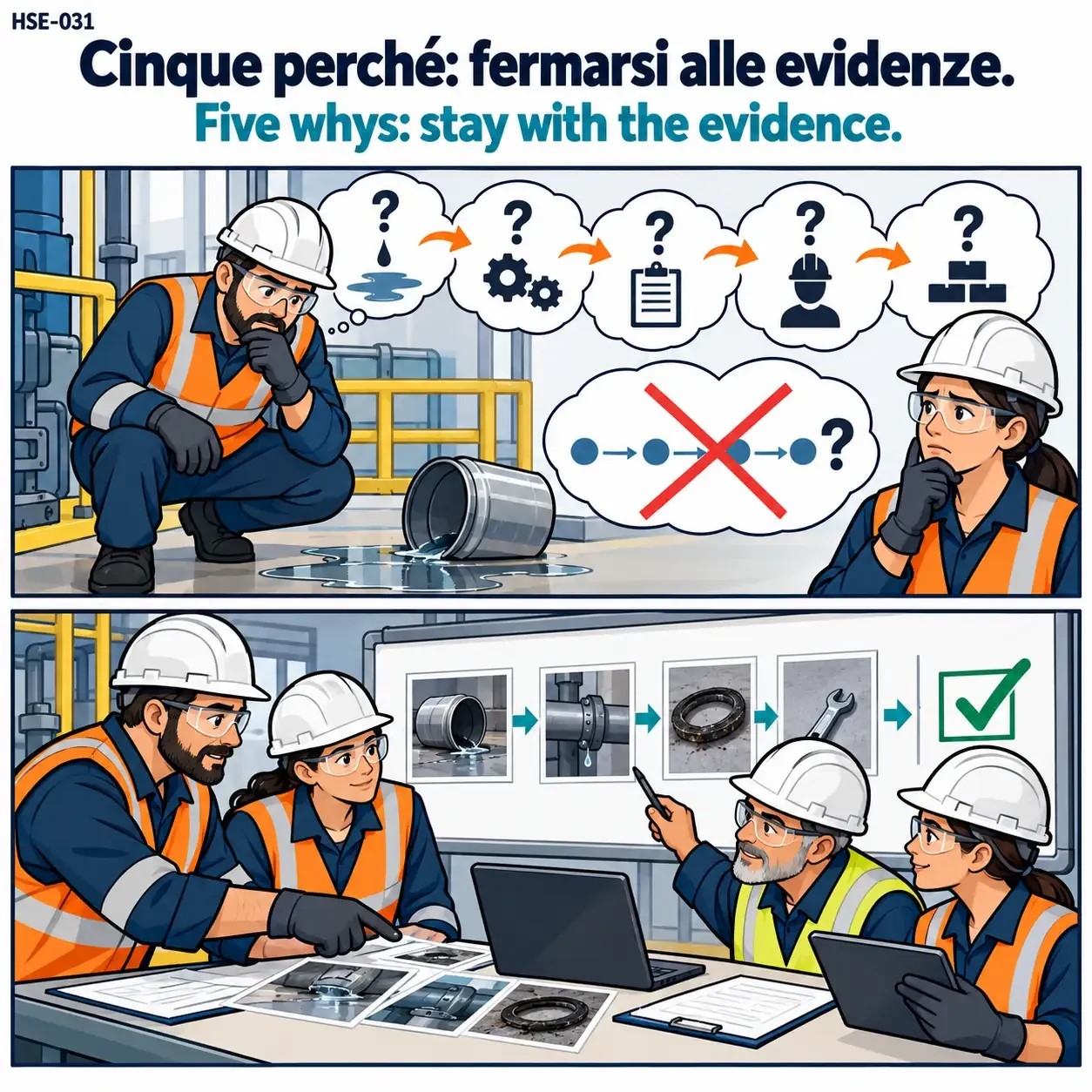
Repeating why can open an investigation, but each step needs support. An elegant chain without evidence can move away from how the process actually works. How do you connect…
Read the insight ↗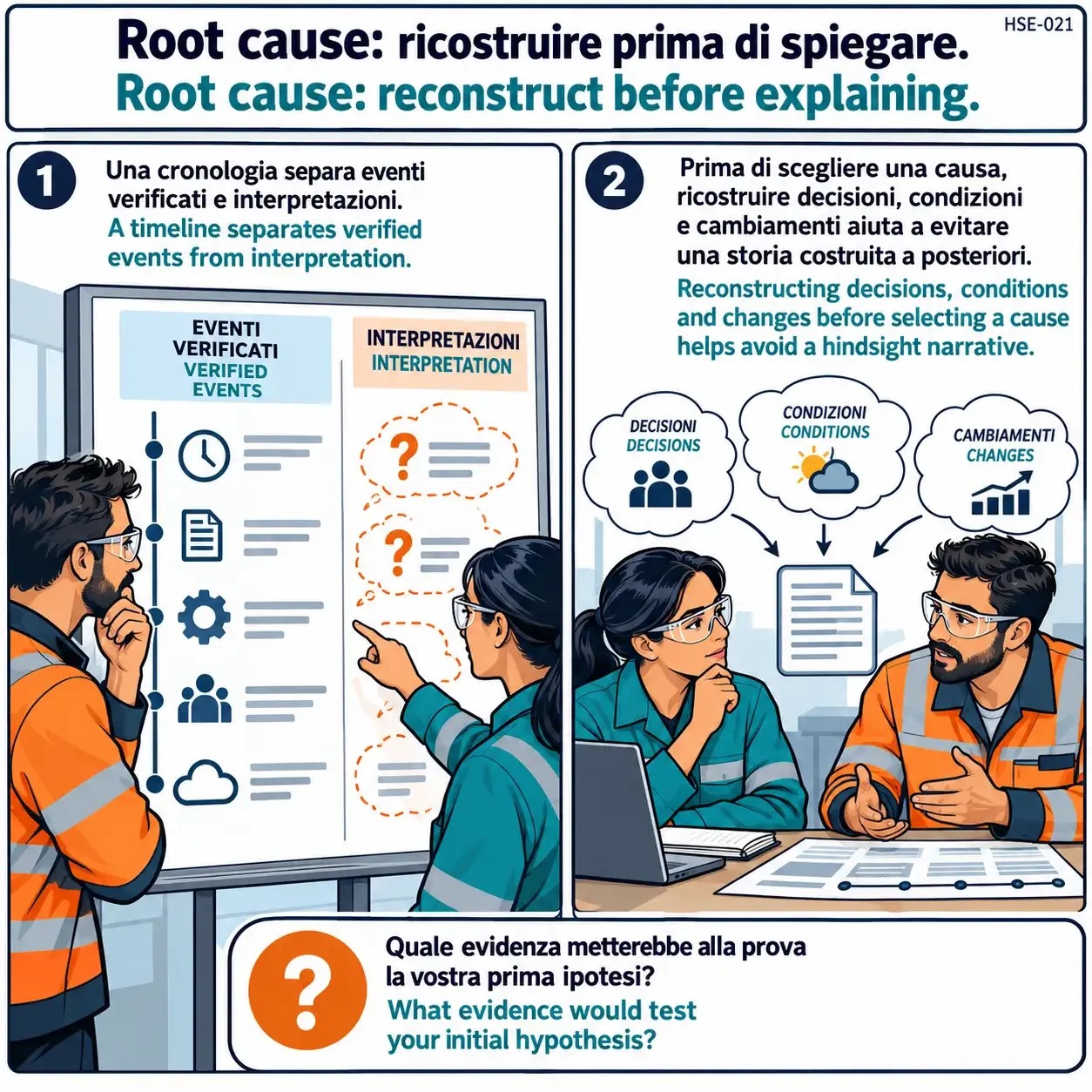
A timeline separates verified events from interpretation. Reconstructing decisions, conditions and changes before selecting a cause helps avoid a hindsight narrative. What…
Read the insight ↗
Root cause analysis and incident investigations
A hand approaching a dangerous part is often the final visible step in a much longer sequence. The InforMO publication released by INAIL on 16 December 2025 examines serious and fatal incidents in the wood industry. Its prevention value lies in connecting the event to equipment, working methods and …
Read the article ↗
Root cause analysis and incident investigations
A collection of serious incidents is more than a catalogue of dangerous situations. The InforMO report published by INAIL on 4 September 2025 examines event dynamics and contributing factors. Its prevention value is to help reconstruct how a sequence developed and where an effective barrier might ha…
Read the article ↗
Root cause analysis and incident investigations
A technical incident investigation and a court decision do not have the same purpose. The INAIL publication of 7 August 2025 brings incident analysis into dialogue with judicial material to examine organisational factors. It offers a useful opportunity to learn from different evidence without confus…
Read the article ↗